Optimism by Necessity
I saw this from the cryptographer Matthew Green: “I think we might lose public key cryptography.” In a follow-up thread, he explained his concern: AI could discover mathematical attacks that weaken the foundations of public-key encryption, including schemes designed to resist quantum computers.
Matthew knows his stuff on this, and I’ll be honest: this was the first time I searched for “How to buy gold coins.”
It’s worth sitting with. A lot of what we trust online depends on public-key cryptography. It helps secure connections to your bank, verify software updates, and establish who you’re communicating with. We’ve built so much on that foundation that it’s easy to stop thinking about it.
There’s been a lot of talk about p(doom): the probability that AI leads to an existential catastrophe. People throw out numbers, but no one really knows.
When I think about AI’s potential for harm, the security implications are what make it feel real to me. More capable attacks. The ability to cause harm at a much larger scale. Even the possibility of breaking the encryption we depend on.
Taking doom seriously
I think p(doom) is worth taking seriously. I haven’t landed on a number. What matters to me is what considering the bad outcome makes you do.
When you honestly picture it, you stop coasting. You start asking what would have to change to prevent it.
In cryptography, the work to prepare has been happening for years. NIST has published post-quantum cryptography standards to help systems prepare for the threat from future quantum computers. We’ve known for a long time that widely used forms of public-key cryptography could eventually need replacing, even if we don’t know the exact date. (I’m also tracking the 2038 problem in software systems.)
I think there’s a place for p(doom) if it leads to action. Fear that leads to paralysis is pointless; fear that leads to action is the point.
A decade of half empty
I’ll be honest about where I’m coming from.
Over the past decade, I’ve grown pessimistic about a lot of things. Institutions, the internet, how we talk to each other, what technology has done to our attention. I didn’t yearn to be a pessimist. It kind of accumulated.
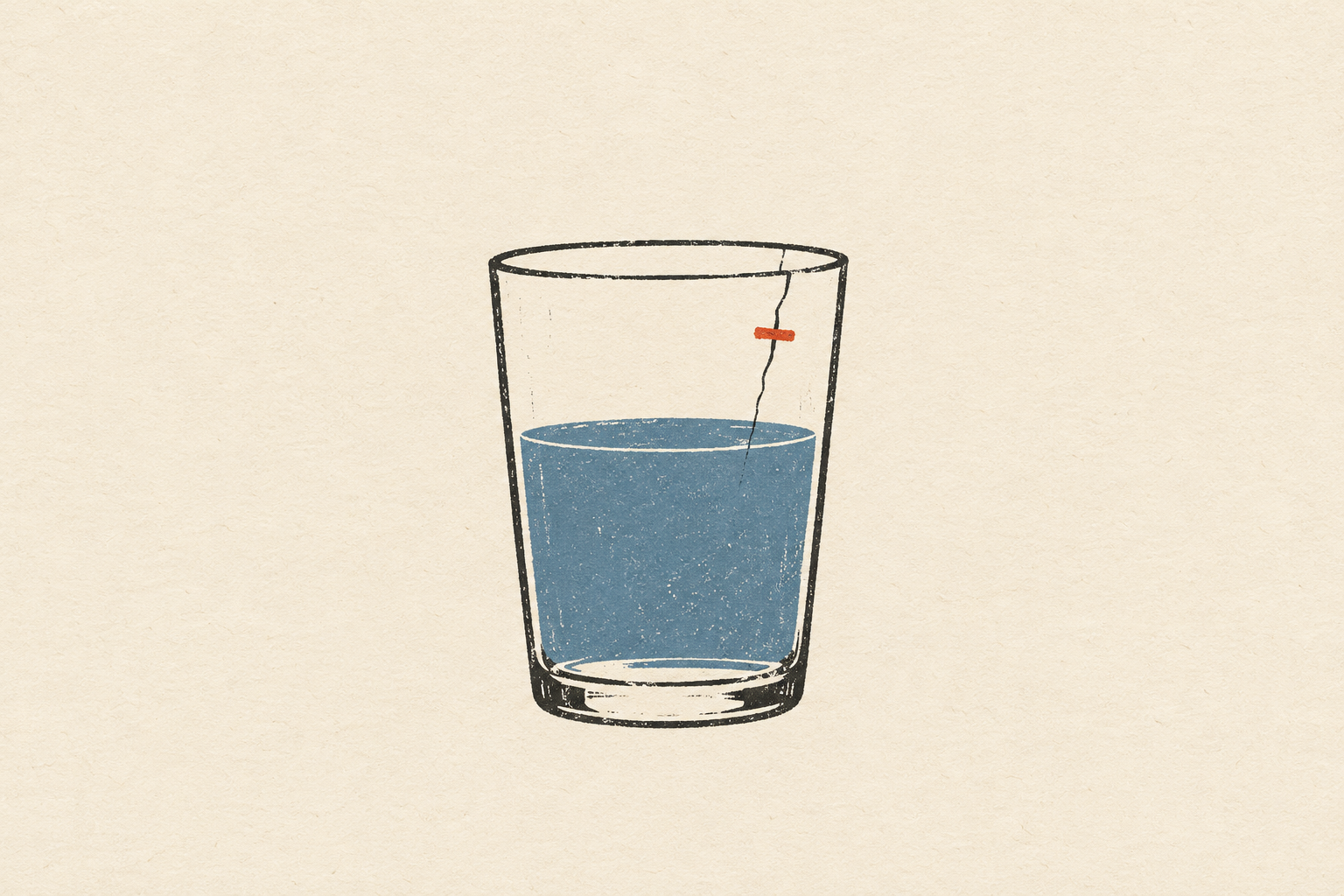
So when AI showed up in a real way, I came at it glass half empty. I can list the concerns without trying. Jobs, slop, purpose, security, climate, power consolidating. I’m not going to pretend those concerns went away.
But when I sit with the tools and look at what’s possible, I see a lot of good too. People building things they never could have built alone. Problems that felt stuck starting to move. Learning loops that used to take weeks taking hours.
Same glass. Depends how you look at it.
Optimism by necessity
I’ve gotten to a point where there’s so much pessimism that the only way through is optimism.
I’ve been trying to find a word for that. The closest I’ve gotten is optimism by necessity. The kind you arrive at after you’ve looked squarely at how bad it could get and realized that despair doesn’t get you anywhere.
If the downside is that big, you don’t get to sit it out. Pessimism makes a great alarm, but it’s a terrible plan.
Optimism, at that point, is a decision. I don’t know that we’ll get through it. But believing we can gives me a reason to do the work.
Don’t accept the conditions you’re given
I stopped writing for a long time. Interestingly, that was around the time I became a bit more pessimistic than optimistic (and had young kids :)).
When I wrote about first principles thinking, the hard part was putting what you know in a box long enough to look at the problem again. This moment asks for that at a much bigger scale.
Going back to the public-key encryption scare, my first reaction was fear and dread. Welp, this was a fun experiment. The longer I sit with it, though, the more I think: well then, a new world order would emerge from the ashes of broken encryption.
If a foundation cracks, a lot of assumptions need another look. How we prove who we are. How we decide what to trust. How software gets built, shipped, and verified. We’ve taken a lot of that for granted. I don’t think we can anymore.
And that habit of questioning assumptions applies beyond security. Some of the things that have felt horrible and permanent might be more open to change than I’ve allowed myself to believe.
I think the right posture right now is to refuse to accept the conditions you’re given. Question the assumptions. Rethink the things that have felt stuck. When the world changes, we have work to do in deciding what comes next.
A reason to act
I’m not going to tell you it’ll be smooth. There’s going to be a lot of change, and some of it—perhaps a lot of it—is going to hurt. Some things we rely on may break, and we’ll have to rebuild them, maybe more than once.
But I feel more optimistic right now than I have in years. The risks are still there. So are possibilities I couldn’t see a few years ago. The mind-bending thing about AI is that it gives us the capability to rethink and rebuild the entire stack, faster and better. And I’m not talking about just the software stack.
Take the doom seriously. Let it wake you up. Then get to work.
The only real way through it is to believe we can get through it, and then act.