Forward Motion & Stop Energy at Startups
This time last year there were 29 people on the Buffer team. Today there are currently 83. It’s been an insane and incredible journey of growth packed into one short year. In this time, we’ve experimented with several organizational changes to keep up. This is now the largest team I’ve ever worked with. It’s so exciting, though one thing that’s on my mind is how can we keep the startup energy and mindset as we keep growing.
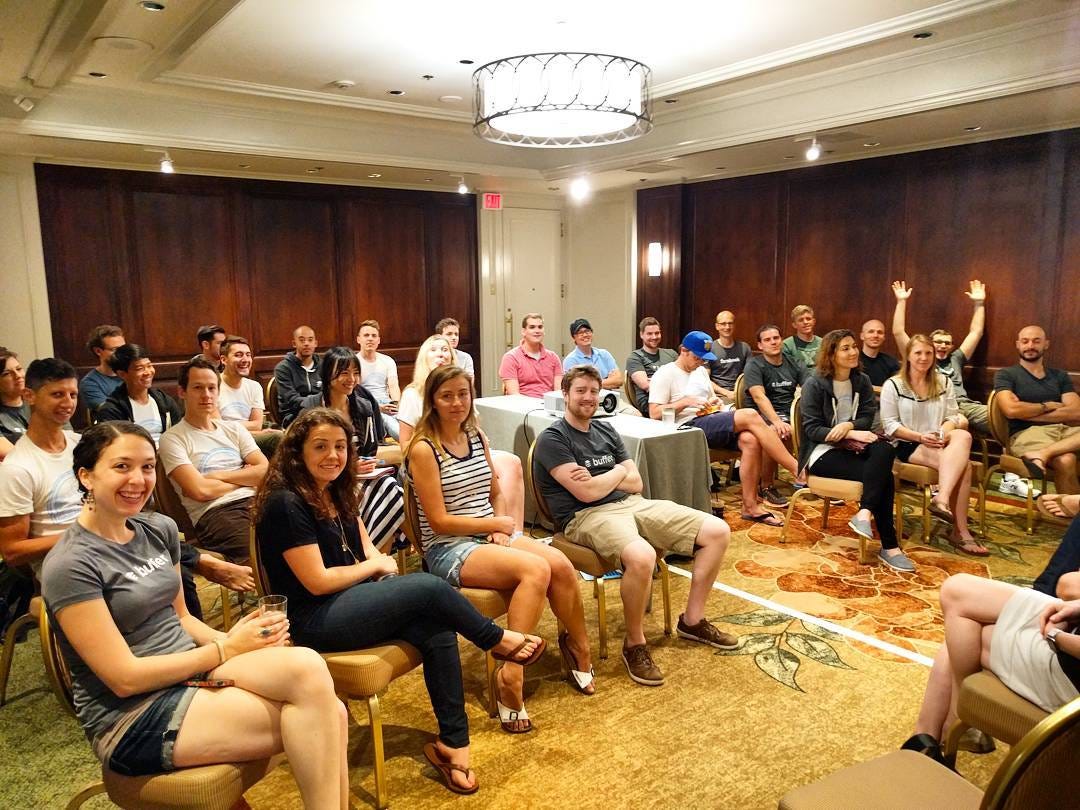
Last fall when I sensed we were going to soon enter hyper-growth mode, I was both excited and scared because it meant a new chapter and ambition and challenges.
I sought advice from a few people I look up to and last September I chatted with Greg Brockman, who was the CTO at Stripe when they were growing fast. I asked him: “How was Stripe able to keep their focus on delivering on many different fronts such as the product, blogging, research and open source as they grew.” Greg pointed me to this concept of Stop Energy, introduced by David Winer in 2002. Ever since reading this, I’ve been finding myself talk a lot about “Stop Energy” with the team. I thought it’d be useful to blog about my take on how Stop Energy relates to a growing startup like Buffer.
Why it’s easier to get stuff done on a small team
When you’re a small team, there are a lot of blurred lines, overlap and trust. Everyone knows what each other are capable of. When making decisions, there are less people to seek advice from, and less people that are affected by those decisions. The feedback loops are quicker, and it’s easier to get on the same page. Therefore when you’re a small team, it is generally easier to get things done.
As we’ve grown each decision affects larger amounts of people and (sometimes rightfully so) things that used to be much easier are now suddenly harder to steer. To keep up, we’ve had to experiment a lot with the structures in place to solve these growth challenges. (I hope to share more about this throughout year!) I can’t say we’ve figured everything out, and I don’t believe we’ll ever figure everything out, though being mindful of ‘Stop Energy’ has allowed me to navigate through some of the challenges of making decisions when more people are on board.
Defining ‘Stop Energy’
At Buffer, the thing that keeps us moving forward is a general Bias towards Action. This is an explicit sub-bullet point in our Be a No-Ego Doer value. Dave Winer calls this Forward Motion. Generally anyone with an idea and wants to move forward with that idea is Forward Motion (FM). The process of ideas turning into action and then into accomplishments is FM. FM is good, everything that we accomplish as a team at Buffer was is represented through FM. In my view, any idea proposed by a team-mate should by default be considered a good idea, because in their shoes, with all the context that person has, they believe it’s a good idea (and it takes a lot of courage to propose an idea). Forward Motion is essentially the reason why working is fun.
When a person seeks advice about an idea they have, depending on their position on the team, how early the idea is, and how many people they seek advice from, they are quite likely to see some sort of Stop Energy.
Stop Energy is the opposing force of Forward Motion — It is essentially advice that slows down the progress of FM. It’s often unreasoned, or provided without attaining full context. It’s essentially saying “that won’t work”, without providing alternatives or valid understood reasoning that’s accepted by both the advice seeker and advice giver.
The potential of seeing Stop Energy increases with more people advice is sought from and is more likely to be seen by new comers than those that have been on the team for a while. I think pervasiveness of Stop Energy is the reason why an environment can become less fun to work at.
Stop Energy Example at the DMV
Take for example the generally accepted view that going to the DMV isn’t fun. When you’re 16, you go into your first experience at the DMV super excited — because you’ll be able to drive for the first time. Your 16 year-old-self going into a DMV represents FM because you have this idea you want to drive and are excited to accomplish the feat of obtaining your license. Immediately you may start to realize there are many barriers and hurdles, (queue times, forms, tests etc). Over time, with so many hurdles to getting something done, the experience then becomes viewed as not fun. Similarly if there are many hurdles and moments of Stop Energy in the critical path of getting something done within any organization, the experience breaks down and becomes less fun, and perhaps burdensome.
How Understanding Stop Energy Changed my Behavior
Discovering the concept of ‘Stop Energy’ was a glass shattering moment for me. Many team members often come to me for advice. That’s certainly a privileged position to be in and because of that, it’s ever so important to be mindful of whether I am Stop Energy. Soon after realizing this, I decided a personal objective of mine would be to approach every meeting with a goal of leaving more excited rather than less excited. I think this is possibly a naive, but accurate gauge of Forward Motion vs Stop Energy. That means, I would try my hardest never to say no without alternatives that are equally exciting. Or it would mean I would refrain from commenting if I wasn’t sure what the best path was here, but instead connect them with someone who might be more helpful.
On the other end, after discovering ‘Stop Energy,’ I’ve found the reason why many times when I have an idea, I would push forward on my own, not telling many people about it until I have something tangible to show. For example, I would come back after a week or two of playing around with a new service or idea, then implement it and get it to a point where I can demo it. I’d then seek the bare minimum advice from the right specific people before moving forward. I realized, the reason why I would do this (completely subconsciously) is because I know seeking advice too early isn’t fair to the advice givers. They would not have full-context to provide accurate advice — and the default is to say no, when someone doesn’t have full context to provide accurate advice.
Now as an advice giver, I try to be super mindful of whether I do have full context or not. If I don’t, I try my hardest to start out saying “I don’t think I have full context here.” (essentially, allowing the advice seeker a route to push forward, even if I might disagree with it with my limited context).
When an advice giver doesn’t have full context, the default advice typically ‘No’.
Stop Energy Propagation
I love the term Stop Energy, because it really does have energy/momentum properties. For example: Lets say ‘Molly’ joined the team two weeks ago. She has an idea and she wants to try it out. From all the context she has, she believes this is a good idea. Molly seeks advice from Bob who has been on the team longer. Bob says that won’t work, without giving more context, great reasoning, or alternatives for Molly to try out. Molly saw Stop Energy from Bob.
A few weeks later Ali joins the team and has another idea. It’s likely Ali will see Stop Energy from Molly because she experienced the same thing with Bob. Stop Energy can quickly propagate and spread throughout a team.
In this case, if Molly had a second idea, it may have been better for her to simply avoid seeking advice from Bob again. Since that is the path way to getting something done. While this isn’t at all ideal, it was probably the path for Molly to move forward. In this case, what’s best for everyone is for Molly to provide feedback to Bob so that he’s able to understand the far-reaching effects of Stop Energy.
Providing Feedback
When I chatted with Greg, he mentioned Stripe had a strong culture of providing feedback whenever the sensed Stop Energy. I think this is super key to prevent Stop Energy propagation across teams and the organization. Since Bob is spreading Stop Energy, it’s critical for Molly to recognize that, and provide feedback to have this stop spreading. Greg mentioned, Stripe team members would say “I’m felt like I received Stop Energy here.” Being so mindful of this may help keep scale a Bias Towards Action with large teams.
Other Examples of Stop Energy
I think Stop Energy comes in many forms, and it might be great to recognize these forms. These were some off the top of my head:
- Many people dependencies to accomplish a task
- Delays when Providing Timely Advice
- Lack of Defined Team Scope and/or Decision Makers
- Lack of clear vision or objectives which can make it hard to know if ideas are aligned
- Leaving a meeting with less excitement than it started out with
- Unnecessary or superfluous processes (several code reviews, paper work, tests)
Explicitly pushing the boundaries of Stop Energy is perhaps the reason why we have our No Ego Doer value and why we believe in ‘Ask for Forgiveness, not for Permission.’
Clarification: Saying No isn’t Stop Energy
I don’t believe Stop Energy means saying ‘this won’t work’ or ‘No’ is a bad thing. Saying No can be great as it ensures focus. In my interpretation, No is Stop Energy when it isn’t fully reasoned or the reasons aren’t fully agreed upon by both the advice giver and seeker. Or if the advice giver isn’t committed to helping the seeker out with viable alternatives yet ready to say no, I believe that is Stop Energy. Now, when I give advice, if I realize something feels like it isn’t the best idea, I try my hardest to work with the person to come up with alternative routes so they can still move forward.
Stop Energy Mindfulness
The next time you might find yourself in an advice giving position, try to reflect whether you’re adding Stop Energy or Forward Motion. After learning about Stop Energy, I can’t remember the last time I’ve said “Nope this won’t work”, or “I don’t think that’s a good idea” and left it at that.
Notes
A huge, huge thanks to Dave Winer for coining this concept and Greg Brockman for sharing it with me — and many thanks to Courtney, Niel and Dan for reading drafts of this post.
I’ve talked to a few of team members about Stop Energy. My hope was to share this post with the entire team and see how this resonates. Thanks so much for reading, and I’d love to hear what thoughts you have on any of this :). Hit me up @sunils34.
Oh, and we’re hiring!